
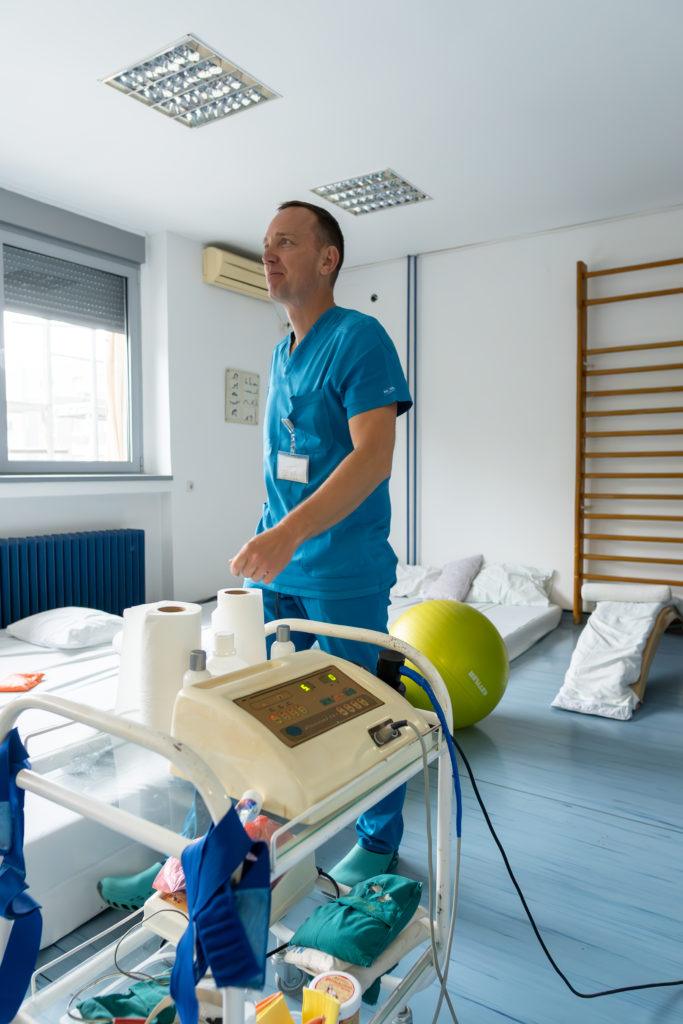
Department of Physical Medicine and Rehabilitation
The activity of the Department of Physical Medicine and Rehabilitation is the rehabilitation of patients as an integral part of the treatment of numerous respiratory diseases, physical therapy, and rehabilitation of all conditions following injuries, fractures, surgeries, and cerebrovascular accidents.
The service is spatially and technically modernly designed and equipped to fully meet all the needs of both inpatient and outpatient patients. It has a room for conducting group respiratory rehabilitation programs, as well as special rooms for inhalations, postural drainage, and specific procedures such as electrotherapy, magnetic therapy, laser therapy, and ultrasound therapy.
The service provides inpatient and outpatient physical therapy upon the recommendation of the attending pulmonologist, for conditions such as: asthma, chronic obstructive pulmonary disease (COPD), pleuritis, chronic purulent infections of the respiratory tract and lungs (bronchitis, bronchiectasis, pneumonia, lung abscess), primary pulmonary hypertension, interstitial lung diseases, preoperative preparation of patients for thoracic and lung surgeries (most commonly due to lung cancer), as well as postoperative treatment of operated patients.
More details
Rehabilitation has been widely applied and continues to be an essential, integral part of modern treatment in various medical disciplines such as orthopedics, neurology, and others. Regarding the application of rehabilitation in internal medicine, it is of a more recent date. In the history of respiratory rehabilitation, it is important to note that the first descriptions of breathing exercises date back to 2500 B.C., and the first names mentioned in the literature related to respiratory rehabilitation are therapist Tisot (1781) and therapist Winifred Linton, who in 1934 in London initiated “localized breathing exercises” for postoperative patients.
Today, there is an increasing need for the introduction of organized respiratory rehabilitation in the treatment of diseases such as COPD (chronic obstructive pulmonary disease), bronchial asthma, but unfortunately also lung cancer, as the sudden and constant rise in the number of patients, as well as the increasingly frequent occurrence in the most productive years of life, leads to premature disability and mortality among the affected.
The main objectives of respiratory rehabilitation are to reduce disease symptoms, restore the maximum possible functional capacity, improve airway patency and decrease the degree of obstruction by removing accumulated secretions, train the patient in proper breathing techniques to enable better and more uniform ventilation of all lung areas, reduce the muscular work required for breathing or the cost of breathing, enhance the quality of life for patients, and increase both physical and emotional participation of patients in daily life, as well as ensure the best and fastest social reintegration. To achieve this, respiratory rehabilitation must also address non-pulmonary issues, which include progressive reduction in conditioning, relative social isolation, mood changes (most commonly depression), loss of muscle mass, and weight loss. It encompasses two fundamental postulates: it requires active patient participation in treatment and it necessitates teamwork among physicians, physical therapists, and nurses.
Patients with various chronic pulmonary diseases benefit from the respiratory rehabilitation program, which necessarily includes physical aerobic training. These benefits are in terms of increased exercise capacity and in terms of reduction of symptoms such as shortness of breath, choking, and fatigue, which these patients report as the most significant symptoms that limit them in their daily lives. The examination has determined that improvement in these parameters occurs after the implementation of the respiratory rehabilitation program, regardless of whether it takes place in a hospital, outpatient clinic, or at home. Ideally, the rehabilitation program for these patients should include breathing exercises, physical training, nutritional counseling, education, and psychosocial support – it is recommended that certain parameters be monitored at the beginning and upon completion of rehabilitation to assess what has been achieved and how much progress has been made.
Individuals suffering from various chronic lung diseases often share some common disease symptoms, including coughing, increased sputum production, and recurrent bronchitis. However, the symptom of shortness of breath is by far the most common reason for their visit to a physician. As the disease progresses, these patients begin to notice that some activities they previously performed routinely now require greater effort and lead to feelings of breathlessness. As a consequence, there is a tendency to avoid initially certain, and later an increasing number of activities, which inevitably leads to rapid deconditioning of the body, and consequently to their more or less pronounced dependence on the bed. Deconditioning is a process that occurs when shortness of breath begins to limit the patient’s physical activities, leading to a loss of muscle strength and cardiac function.
To avoid these extreme stages of psychophysical and social isolation of patients, respiratory rehabilitation should be initiated as soon as possible, very soon after the diagnosis is established.
Procedure in Service
In our service, according to the latest standards and principles of good clinical practice, the following procedures are performed:
Inhalations using the most advanced inhalers, which operate on the principle of compressed air or ultrasonic nebulization of medicinal particles. The solutions that are inhaled can be at room temperature or heated, and can be inhaled under increased pressure or with the addition of oxygen as needed.
Postural drainage is performed on hospitalized patients being treated for bronchitis, pneumonia, abscesses, and bronchiectasis, in a special room equipped with an oscillating bed.
Manual and vibrational massage is performed to reduce muscle spasms used in breathing.
Relaxation exercises are most commonly applied to patients suffering from asthma and involve group work.
Breathing exercises are one of the most important methods in the treatment of patients with chronic pulmonary diseases (bronchitis, emphysema, cystic fibrosis, pleuritis).
Strength exercises are used to strengthen the muscles of the upper and lower extremities; they are conducted in groups, for patients with COPD, bronchial asthma, interstitial lung diseases, pulmonary arterial hypertension, as well as in preoperative preparation.
Behavioral therapy represents a set of exercises performed individually or in groups for patients with asthma, COPD, primary pulmonary hypertension, and interstitial lung diseases.
Low-level laser biostimulation and magnetotherapy are conducted for patients with obstructive diseases (asthma, COPD).
Physical therapy is also conducted for other mentioned conditions where, according to the indication of the physiotherapist of the Service, the following are applied: kinesiotherapy, electrotherapy, magnetotherapy, laser therapy, and ultrasound therapy.